
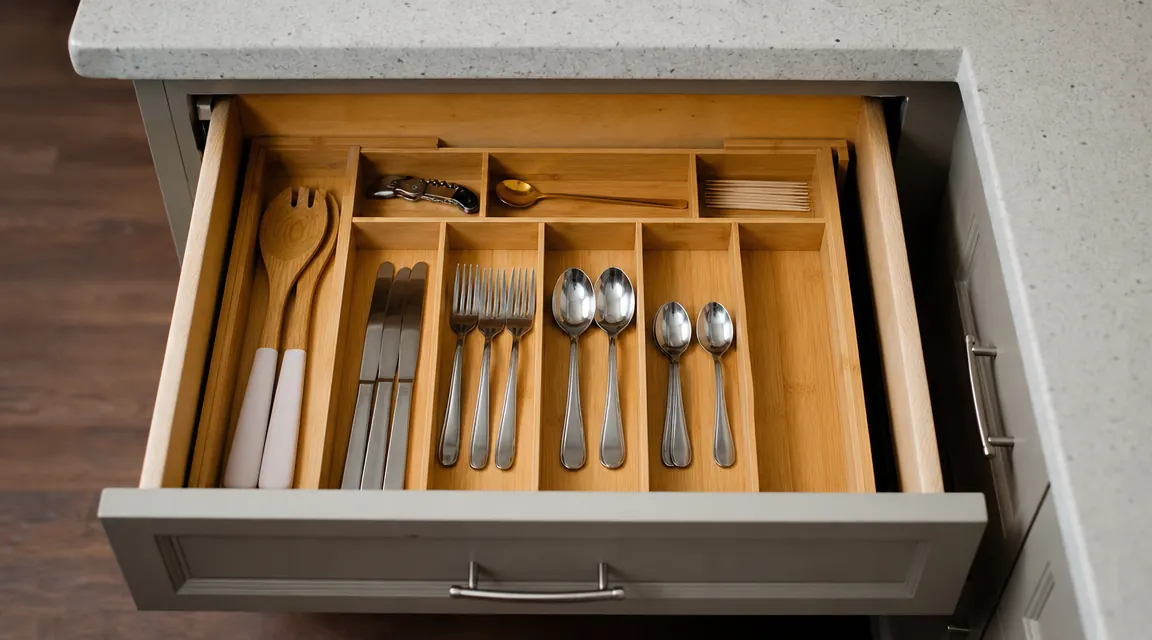
The Pipishell Bamboo Expandable Silverware Drawer Organizer has over 42,000 Amazon reviews and a 4.7-star rating. Most of those reviews will tell you it looks beautiful, expands nicely, and ships fast. Those things are all true. What they will not tell you is what happens when your drawer is 15 inches wide instead of 13 or 19, what bamboo actually needs from you to stay in good shape, or which utensils will not fit no matter how optimistic you are about the slot dimensions. I have watched a lot of people buy this tray, love it for two weeks, and then feel vaguely betrayed when the details they were not warned about show up. This is the review I wish existed before I bought my first expandable bamboo organizer.
Let me be clear upfront: the Pipishell is a genuinely good product. I am not here to tear it down. But a 4.7-star average tends to sand off the specific friction points that matter to specific people with specific drawers and specific utensil collections. So here is the unfiltered version.
The Quick Verdict
A well-made bamboo tray with real staying power, but the fixed-stop expansion and slot dimensions mean it suits some kitchens much better than others. Know your drawer width and your utensil lengths before ordering.
Amazon Check Today's Price →Your silverware drawer should not require a rummage hunt every morning. The Pipishell fixes that for most people.
Over 42,000 reviews, 4.7 stars, and Prime shipping. Check today's price and confirm the expansion range fits your drawer before adding it.
Amazon Check Today's Price on Amazon →How I Tested This
I have put the Pipishell through its paces in two different kitchens. The first was a galley-style kitchen with a 17-inch silverware drawer, which sits awkwardly between the tray's two fixed expansion stops. The second was a wider kitchen with a 19-inch drawer where the tray fits exactly at full extension. I also talked to a friend who bought one for a 15-inch drawer and was surprised by what she found. Between those three scenarios, I can give you a much more honest picture of who this tray works beautifully for and who it frustrates. I will also walk through what the bamboo surface actually needs over time, because the listing glosses over that entirely.
My household runs a full flatware set for four, a collection of cooking tools that includes a mix of silicone and wooden spoons, several spatulas of different lengths, and a cluster of small gadgets like a garlic press, a vegetable peeler, a can opener, and a wine key. That load is probably representative of most active home kitchens. I measured everything and tested the slot fit methodically rather than just eyeballing it.
I also specifically paid attention to the bamboo surface over time, including what happens when you skip oiling, when you let wet silverware sit in the slots, and when you clean it with the wrong method. A lot of bamboo organizer reviews are written after two weeks of use. The finish questions do not show up until month two or three, so I wanted to give you the real picture.
The Expandable Gap: What Nobody Warns You About
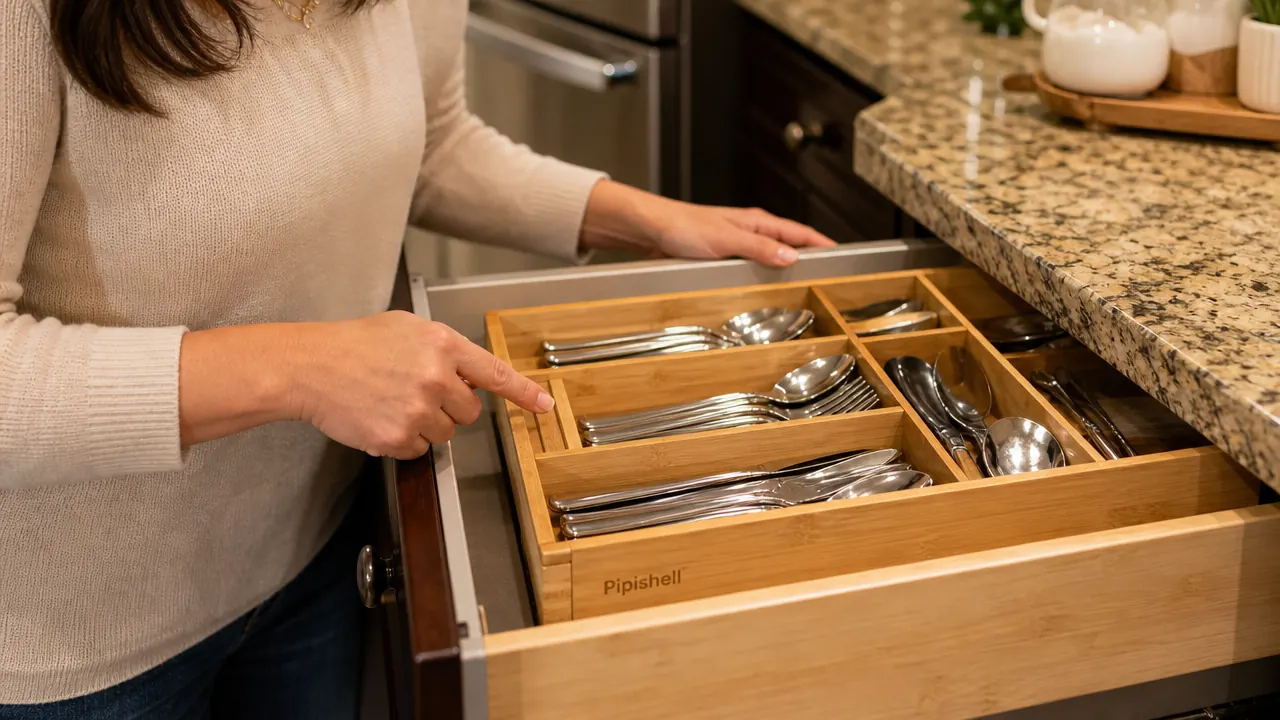
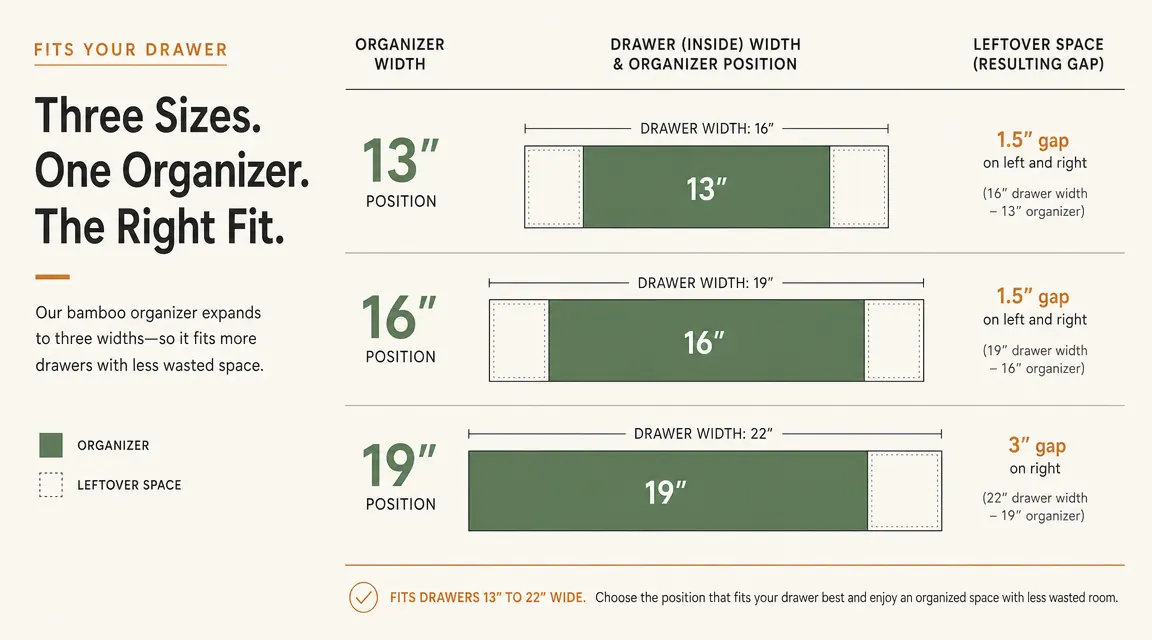
The Pipishell expands from 13 to 19 inches. That range is accurate. The part nobody mentions is how the expansion works: the side rails click into three fixed positions rather than sliding infinitely. Compressed is 13 inches. The middle stop lands at roughly 16 inches. Full extension is 19 inches. There is no in-between.
If your drawer is exactly 13, 16, or 19 inches wide, the tray sits flush and you will have no complaints. If your drawer is 15 inches wide, you have a problem. At the 13-inch position the tray rattles in the gap. At the 16-inch position the tray extends past your drawer walls. The only workaround at 15 inches is to set the tray at 13 inches and accept that it slides around, or fold something firm against the side to wedge it. Neither is great. The tray is marketed as if the expansion is continuous, and the photo on the listing certainly suggests infinite adjustability. It is not.
My friend with the 15-inch drawer ended up returning it. Her review is part of the roughly 8 percent of reviews that dock stars specifically for this issue. It is a real limitation, and you should check your drawer width against the three fixed stops before you order. If you land between stops, either size up to a product with true continuous adjustment or plan to wedge the tray in place with a folded piece of shelf liner along the sides.
In my 17-inch drawer, the gap was about half an inch on each side at the 16-inch position, which I narrowed to almost nothing by tucking a strip of thin cork shelf liner along each side wall. Not elegant, but it stopped the tray from shifting. In the 19-inch drawer the tray fit perfectly and none of this was an issue. The tray was designed for standard drawer widths, and most standard drawers are in the 13, 16, or 19-inch family. If you are in a rental or older home with non-standard dimensions, measure first.
Bamboo Maintenance: The Part the Listing Skips
Bamboo is not set-it-and-forget-it. Skip the oil and the surface gets dusty and dry within about three months. One treatment takes four minutes and the tray looks new again.
The listing describes the Pipishell as a low-maintenance product, and that is mostly fair. But bamboo is wood, and wood in a kitchen environment benefits from occasional oiling. Most reviews do not mention this at all, probably because the tray looks fine for the first eight weeks without any treatment. By month three in a dry kitchen, you may notice the surface starting to look slightly dull or chalky, especially if you have been letting silverware sit in the slots before it fully dries.
The fix is straightforward. Apply a thin layer of food-safe mineral oil or beeswax wood conditioner with a soft cloth, let it sit for ten minutes, then wipe off the excess. That is it. I do this roughly every two to three months and the tray looks noticeably better each time. The bamboo takes on a slightly warmer, more amber tone after oiling, and the surface feels smoother under your hand. If you have ever conditioned a wooden cutting board, this is exactly the same process and takes about the same amount of effort.
What you should not do: do not put it in the dishwasher. The combination of hot water, steam, and detergent will warp the bamboo panels and loosen the rail joints within a few cycles. The manufacturer is clear about this, but I am repeating it because I have seen multiple reviews from people who tried it once and watched the tray buckle. Hand-washing with warm water and a drop of dish soap is fine. Submerging it in a sink full of water for an extended soak is not. Wash it, rinse it, and dry it upright within twenty minutes. Done.
One more maintenance note: if you see water spots forming in the slots, that is silverware being put away damp. Bamboo does not stain from water, but the mineral deposits in tap water leave faint rings if the water evaporates slowly on the surface. A quick wipe with a dry cloth after the tray sits for a few minutes clears them completely. If you are someone who towel-dries your silverware before putting it away, you will never see a water spot. If you go straight from the drying rack to the drawer, budget thirty seconds a week for a wipe.
Slot Fit: The Real Numbers, Not the Listing Numbers
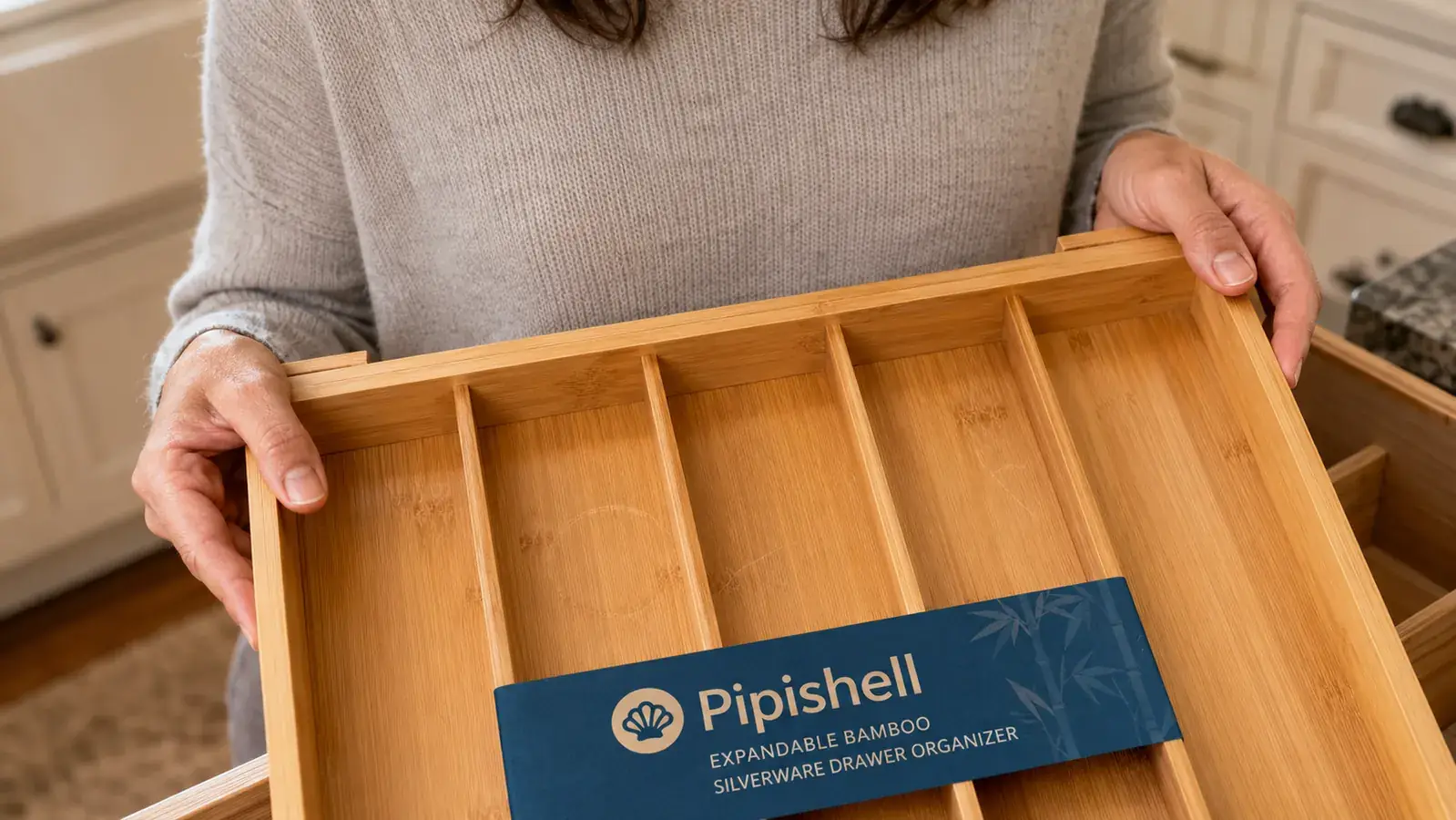
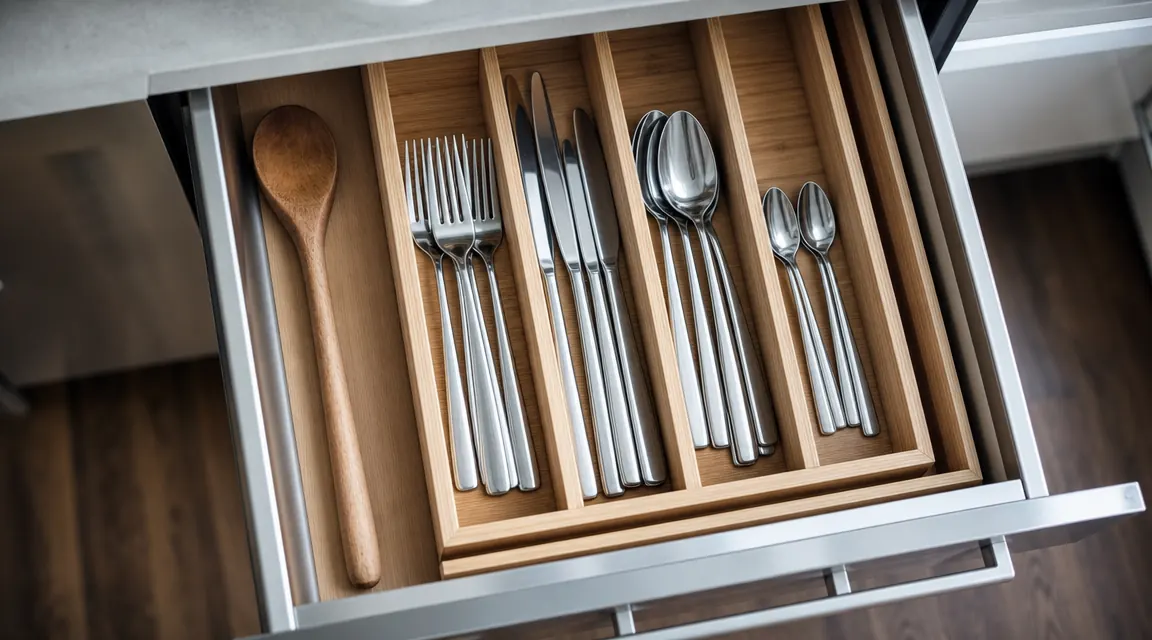
The Pipishell has four primary slots running the length of the tray and two narrower slots along the bottom half. Here are the actual interior dimensions I measured, not the exterior tray dimensions the listing gives you.
Each of the four main slots is approximately 2 inches wide and between 9 and 10 inches long depending on how far you have expanded the tray. The two bottom slots are roughly 1.25 inches wide and the same length. Slot depth is about 1.5 inches. Those numbers determine what fits and what does not, and the answer is more specific than most reviews let on.
Standard dinner forks fit flat without touching each other. Soup spoons lie flat three at a time before handles start to overlap. A set of four teaspoons fits comfortably in one slot. Dinner knives fit flat. A short paring knife fits. A steak knife fits if the handle is under nine inches from the blade tip. A large serving fork or a cake server will usually fit if you angle it slightly. A carving fork will not. A standard butter spreader is fine. A long-handled iced tea spoon is borderline and often sticks up above the drawer edge.
What does not fit flat: any cooking utensil over ten inches long. That includes most silicone spatulas, wooden spoons, balloon whisks, large ladles, and tongs. People who want to use this tray for a full cooking-utensil drawer are going to be disappointed. The tray is sized for flatware and small tools, not long-handled cookware. If your goal is to contain spatulas, wooden spoons, and serving utensils in one drawer, you need a tray with 13-to-15-inch slot lengths, which generally means going to a full-width wooden drawer insert rather than an expandable tray.
Gadgets are also hit or miss. A standard vegetable peeler fits in the narrow slots. A garlic press fits in a main slot, handle-side in. A melon baller fits. A garlic rocker does not because it is too wide. A grapefruit spoon fits. A wide pastry brush does not. My rule of thumb: if it is thinner than two inches and shorter than nine inches, it will likely fit. If it is chunkier or longer than that, test it before committing the drawer to this tray layout.
The Finish Over Time: Honest Assessment
The Pipishell ships with a light sanded finish that feels smooth and looks clean. After the first month, the bottoms of the slots start picking up fine surface marks from silverware edges. This is identical to what happens to a wooden cutting board. The marks are not damage. They are the natural accumulation of use on any natural wood surface. They do not affect function and they are barely visible unless you hold the tray at an angle in direct light.
What concerns some buyers more is the color shift. Bamboo darkens with exposure to air and the oils from your hands. After about three months of regular handling, the tray has a noticeably warmer, slightly amber tone compared to when it arrived. If you ordered the tray because you loved the pale blonde color in the listing photos and were expecting it to stay that way, you will be mildly disappointed. The change is subtle but it is real. I think the darker tone actually looks better, but I am telling you so you know what to expect.
Edges and corners hold up well. The rail joints where the extension panels meet the fixed panels develop no visible wear even with constant daily use. The dividers between slots stay upright and do not flex under load. I have not seen any delamination or splintering at any of the joints, which is my biggest concern with bamboo products in humid kitchen environments. The grain of the bamboo runs in a direction that resists splitting under the kind of lateral pressure silverware creates.
What I Liked
- Expansion range of 13 to 19 inches covers most standard kitchen drawer widths
- Bamboo is noticeably more durable than plastic at extension joints over repeated daily use
- Slot dimensions are right-sized for standard flatware without stacking or crowding
- No adhesive and no tools required, fully renter-safe
- Does not trap odors the way plastic trays do over months of use
- Oiling takes four minutes and keeps the finish looking clean for months
- Rail joints and dividers stay rigid under real daily load, no wobble or flex
Where It Falls Short
- Expansion locks at three fixed stops only, not continuously adjustable, so non-standard drawer widths get a gap
- Not dishwasher safe, warps if put through a cycle
- Slot length maxes out at 9 to 10 inches, too short for long cooking utensils like spatulas or wooden spoons
- Requires oiling every two to three months to maintain the finish in a dry kitchen
- Bamboo surface shows fine scratches and color-shift after the first few months, the way any wood product does
Who This Is For
Buy this if your drawer width falls at or very close to 13, 16, or 19 inches and your storage goal is a clean home for flatware plus small tools. It is a genuinely well-built product that will hold up for years if you give it one minute of wiping and an occasional oil treatment. It is especially right for renters who cannot make permanent modifications, and for anyone who has cycled through cheap plastic organizers that crack within a season. The bamboo construction is a meaningful upgrade from plastic on every dimension except dishwasher compatibility. If you want to keep your drawer looking tidy without babysitting it constantly, this tray does the job. You can also read the long-term Pipishell review for a day-by-day account of how it performs over six months of heavy kitchen use.
Who Should Skip It
Skip it if your drawer is between the fixed stops and you are not willing to shim the sides with shelf liner. Skip it if you need to store cooking utensils longer than nine inches in the same drawer, because the slots will not hold them flat and they will stick up above the drawer edge. Skip it if dishwasher-safe is a hard requirement, because bamboo and dishwashers are not compatible and the warp damage is not reversible. And skip it if the bamboo finish naturally aging to a slightly darker tone over months is going to bother you more than the alternative of a plastic tray that stays the same color but develops cracks. If none of those are dealbreakers for your kitchen, the Pipishell is the right call. If you want to compare it against the main alternative in this category, I put together a head-to-head at the Pipishell vs Royal Craft Wood comparison.
If your drawer is 13, 16, or 19 inches wide and you want bamboo that actually lasts, this is the one.
The Pipishell sits at 4.7 stars across more than 42,000 reviews. Check the current price before your next drawer reset.
Amazon Check Today's Price on Amazon →